Blog
Page 2 of 2. Older posts from the Robotomail blog.
Send Email Using JavaScript and the Robotomail API
Use server-side JavaScript to send email, protect the API key, handle failures and connect inbound replies to your application.
Read post
How to Send Email with Python and the Robotomail API
Send from Python using the standard library, check HTTP errors and connect incoming replies to a mailbox workflow.
Read post
Transactional Email API: Developer's Guide 2026
Master transactional email API. Learn how it works, best practices, security, and choose the right one for your app in 2026. Start now!
Read post
What Is Email Threading? Headers, Replies and Agent Context
Understand Message-ID, In-Reply-To and References, keep API identifiers distinct, and debug threaded replies in an agent email workflow.
Read post
Best Email APIs for AI Agents: A Workflow Comparison
Evaluate sending, receiving, mailbox identity and conversation state across email APIs. Build and test a Robotomail workflow, then inspect detailed comparisons.
Read post
Email API for AI Agents: Integrate LangChain & AutoGen
Explore the email API for AI agents. Understand its unique advantages vs. SendGrid/Gmail & seamlessly integrate into LangChain/AutoGen stacks. 2026 guide!
Read post
Email Can Receive But Not Send: A Developer's Guide
Troubleshoot why your email can receive but not send. A step-by-step guide for developers on fixing SMTP, API, DNS, and provider block issues.
Read post
Email for AI Agents: Email Infrastructure Guide 2026
Email for AI agents explained: why agents need native mailboxes, how to handle inbound via webhooks and SSE, and how to build durable thread-aware workflows.
Read post
Email Workflow Automation for AI Agent Mailboxes in 2026
Build email workflow automation for AI agents with mailboxes, webhooks, SSE, and thread state. Skip legacy SMTP and OAuth with agent-native infrastructure.
Read post
How to Use AI to Answer Emails: An Agent Developer's Guide
Learn how to use AI to answer emails by building an autonomous agent. This end-to-end guide covers API setup, prompt engineering, context, and deliverability.
Read post
Build an AI Agent to Manage Emails: 2026 Developer Guide
Build an AI agent to manage emails with Robotomail. This 2026 guide covers API provisioning, LangChain and CrewAI integration, and autonomous deployment.
Read post
AI Email Assistant: Build Autonomous Agent with Robotomail
Learn to build an autonomous AI email assistant. This hands-on guide covers using the Robotomail API for mailboxes, webhooks, threading, and LLM integration.
Read post
Agentic Email & Inbox for AI Agents: Architecture Guide
What agentic email and an agentic inbox are, and how to build them: architecture, security, and LangChain/CrewAI integration for autonomous agents.
Read post
AI Agent Email: Developer Guide to Agent Mailboxes
Learn what AI agent email is, how it works, and why it's essential for autonomous agents. A complete guide to architectures, integrations, and best practices.
Read post
Email Integration for AI Agents: A Complete Guide (2026)
A complete guide to email integration for AI agents. Learn to create mailboxes, send and receive via REST API, manage threads, and set up custom domains.
Read post
Send Emails with Attachments Using the Robotomail API
Upload a file, reference its attachment ID in a send request, retrieve incoming files and handle access, size and delivery errors.
Read post
Webhooks vs WebSockets: A Guide for AI Agent Developers
Webhooks vs WebSockets: which is right for your AI agent? This guide compares latency, reliability, and scaling, with Robotomail patterns for developers.
Read post
API for Email: A Practical Guide for AI Agent Developers
Learn how an API for email unlocks autonomous workflows for AI agents. This guide covers features, implementation patterns, and agent-native solutions.
Read post
Email for Claude Code: Give Your Agent a Live Inbox
Give Claude Code a real email inbox. Install the plugin, add a mailbox, and Claude sends and replies to email autonomously. Setup in minutes.
Read post
Your Robotomail API Quick Start to Autonomous Email
Robotomail API quick start for autonomous agent email. Create a mailbox, send your first message, and handle inbound replies with webhooks or SSE in minutes.
Read post
AI Agent Email: Build vs Buy vs Hack Together
Self-hosted mail server, Gmail API hacks, or a purpose-built agent email service? A practical decision framework covering real trade-offs for each approach.
Read post
How to Receive Inbound Email via Webhook
Set up webhook-based inbound email for your AI agent with Robotomail. Register a webhook, verify HMAC signatures, parse messages, and reply in-thread.
Read post
Send Email from an AI Agent (Python + Node)
Send email from your AI agent in under five minutes. Code examples in Python and Node.js for basic sends, HTML email, threading, and a complete agent loop.
Read post
Email for AI Agents: Why SMTP Doesn't Work
SMTP is a 40-year-old protocol designed for server-to-server relay. Here's why using it directly for AI agents is the wrong abstraction and what to use instead.
Read post
4 Ways to Get an Email Address for an AI Agent
The four ways to give your AI agent an email identity: Gmail, forwarding aliases, transactional APIs, and agent-native platforms. Trade-offs for each option.
Read post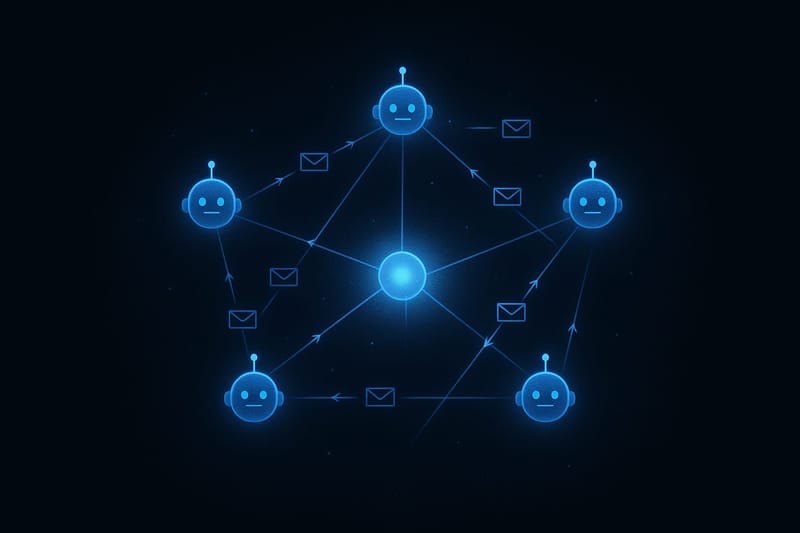
Email Infrastructure for Multi-Agent Systems
How to architect email for systems with multiple AI agents: mailbox-per-agent, shared domains, threading across agents, security patterns, and scaling.
Read post
Why Your AI Agent Needs a Real Inbox Now
Send-only email is a dead end for AI agents. Without inbound, your agent can't handle replies, thread conversations, or close the loop on any real workflow.
Read post
Why Gmail and Outlook APIs Fail AI Agents
Compare mailbox provisioning, OAuth credential management, account administration, pricing, and quotas when connecting AI agents to Gmail or Outlook.
Read post
Introducing Robotomail: Email for AI Agents
Why we built a purpose-built email REST API for AI agents, how it works, and what makes it different from Gmail, SendGrid, and self-hosted mail servers.
Read post